ANNUAL STAR · YOUR FOUNDATION
Nine Star Ki
NINE STARS · FIVE ELEMENTS
Your nature.
The rhythm of your cycles.
Discover your birth stars and explore your current phase through Japanese Ki.
Discover my stars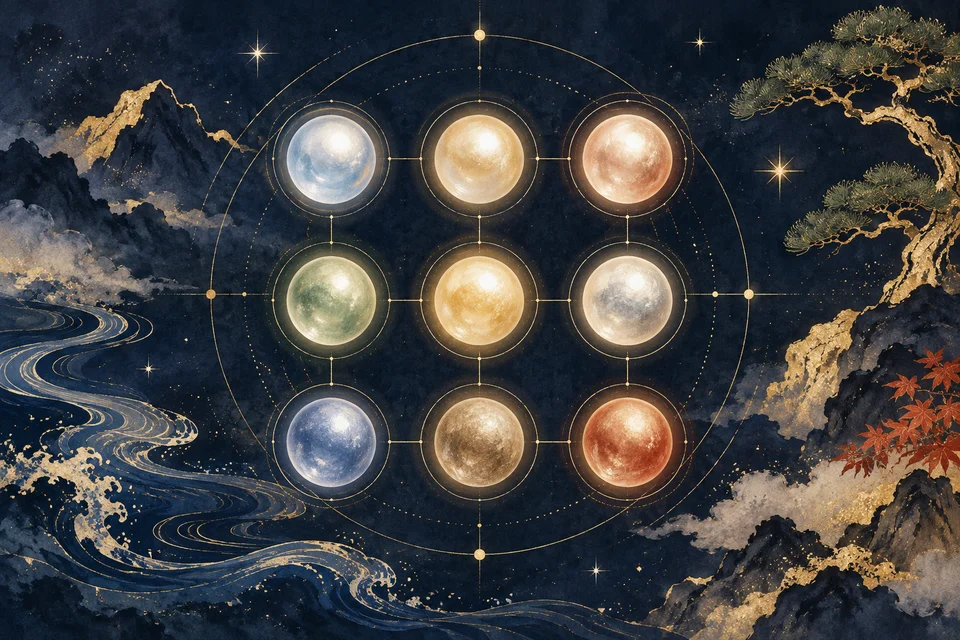
YOUR NINE STAR MAP
MONTHLY STAR · YOUR INNER NUANCE
The annual star describes your underlying tone; the monthly star adds an emotional response pattern. They complement each other.
A NINE-YEAR JOURNEY
Which phase are you in?
Switch years to explore the theme of each phase.
Annual chart · south at the top.
The golden square marks your star.
Each house is a symbolic phase, not a luck score or a promise of future events.
See how my result is calculated
Saving keeps your stars, possible alternatives and selected cycle in this browser. Sharing sends only the link.
How we calculate Nine Star Ki
We use the annual star (honmeisei), monthly star (getsumeisei) and annual passage through the nine Lo Shu houses. The calculation is the same regardless of sex. This is not a Kua number, a BaZi chart or an astronomical chart of nine celestial bodies.
The year begins at Risshun or Li Chun, when the Sun reaches 315° ecliptic longitude, not on 1 January or always on 4 February. Months begin at the twelve opening solar terms rather than on the first day. We use the solar instant converted to the birth timezone. Schools using the whole calendar day may give different results close to a transition.
Reduce the solar year to one digit and subtract it from 11, wrapping to 1–9. In the first solar month, annual stars 1/4/7 start at 8; 2/5/8 at 2; 3/6/9 at 5. The monthly star moves back one number each month. For the cycle, place the year’s star at the centre of the Lo Shu and locate your annual birth star.
Solar dates come from a precalculated lunar-php table. We apply a two-minute margin near its boundaries. Without a birth time, we examine all actual instants in your local date, including clock changes, and retain the possible combinations. An unknown time is never replaced by noon. Birth dates are supported from 1900.
The readings are original texts inspired by this tradition’s symbols. We do not calculate favourable travel directions, health diagnoses or predictions of events.
Sources: YGO-JAPAN (monthly table) · annual chart · lunar-php.
A symbolic reading for entertainment and personal reflection.
What is Nine Star Ki?
Nine Star Ki, also known as Kyusei Kigaku, is an East Asian symbolic system developed in Japan. It connects nine numbers with five elements —water, wood, fire, earth and metal— and the cycles of the solar calendar.
You do not need to know astrology to begin. Your birth details reveal two personal keys: an annual star representing your underlying nature and a monthly star adding a nuance to your responses. You can then explore nine years and the theme associated with each phase.
Two complementary birth stars
The annual star comes from your solar birth year. The monthly star combines that star with your solar birth month. Sharing a year does not mean having the same profile: the month introduces another nuance.
The symbols make the stars easier to remember: river for water; thunder and wind for wood; field, centre and mountain for earth; sky and lake for metal; light for fire. These are images for reflection, not labels that dictate your behaviour.
Why early February can change the result
The Ki year begins at Risshun or Li Chun. A January birth, or one before that transition, may belong to the previous solar year. The exact date and time vary; a calculator switching every year on 4 February can differ near the boundary.
Months also begin at solar terms. This tool uses those instants and your birth timezone. If an unknown-time date spans a transition, it shows the possible combinations rather than selecting one at random. Open the calculation details below the result to check.
Reading your annual cycle
Your birth star stays the same; its house in the annual chart changes. The highlighted position has a short reading for relationships, projects and a practical step. Switch years without entering your details again.
No year guarantees success or failure. The aim is to reflect on symbolic rhythms: preparing, beginning, connecting, reviewing or completing. The chart is not a reason to postpone important decisions.
Is it the same as BaZi or Feng Shui?
No. BaZi Four Pillars uses another calendar and interpretive structure. The home Feng Shui map works with areas of your home. This app focuses on personal stars and cycles, not Kua numbers or travel directions.
You can also explore your Nakshatra, a different tradition whose starting point is the Moon’s position at birth.