Destiny Matrix
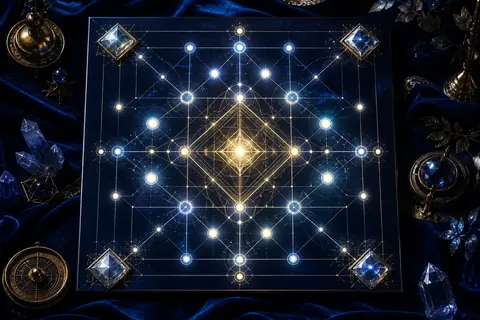
Enter your date of birth and you will get your octagram: nine points, each holding one of the 22 major arcana. Your character, your talents, the inheritance of your family lines, your destinies by age — and the energy of your essence at the centre.
The energy of your essence
In light:
In shadow:
Advice:
Your personal points
The ancestral square
Your destinies
The love and money channel
The programmes of the past
How it is calculated
Calculated with the classic Destiny Matrix scheme: every number is reduced to 22 or less, and each one corresponds to a major arcanum. Take the readings as a mirror and a suggestion, not a verdict: the same energy can be lived in light or in shadow — and that part is up to you.
The Destiny Matrix is the method that joins numerology with the 22 major arcana of the tarot. The rule is simple and it changes everything: here no number is reduced to a single digit, as in classical numerology, but to 22 or less — so every result is not an abstract figure but an arcanum with a face, a story and a character. Your day of birth is a card; your month, another; your year, another still. And from the crossing of them all comes your octagram: the eight-pointed star you see above.
Each point of the star answers a different question. The central diamond holds your four personal energies: the character you were born with, the talents you brought along, your way of making your mark in the material world, and the karmic luggage you carry. The rotated square is your ancestry: what reaches you — gifts and unfinished tasks alike — through your father's line and your mother's. And at the centre, the most important card of all: your essence, the energy you rest in and from which everything else falls into place.
The matrix adds what classical numerology lacks: the destinies by age (your personal task up to 40, the social one up to 60, the spiritual one after that), the love and money channel, and the three programmes of the past — the lower points of the star, read together as the to-do list you arrived in this life with.
Every energy can be lived in light or in shadow, which is why each card shows you both faces and a piece of advice to work with it. Take it for what it is: a map, not a sentence. The territory — what you do with each card — is yours to walk.